
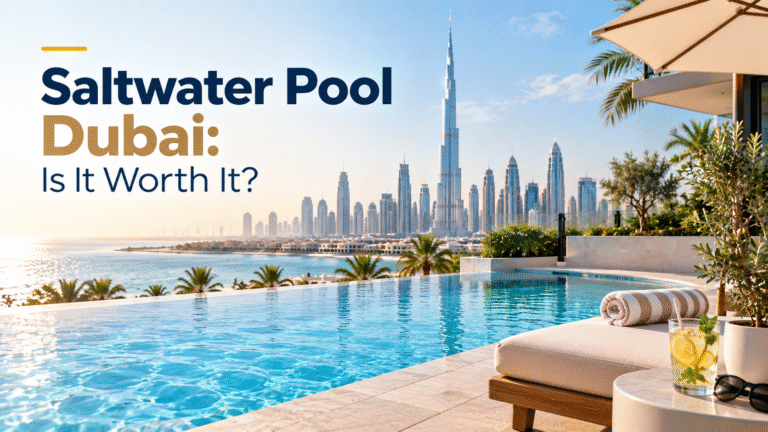
Saltwater pools are the most consistently misunderstood upgrade in the Dubai pool market. The name creates two misconceptions simultaneously: that a saltwater pool is filled with seawater (the salinity is around 3,000 ppm — roughly one tenth of the ocean), and that it eliminates chlorine (it does not — a saltwater pool produces chlorine continuously through electrolysis rather than requiring manual addition).
The question Dubai pool owners are actually asking is: will the water feel better, will maintenance be easier, and is the cost justified? These are answerable questions, and the honest answer varies depending on the pool, the owner, and the existing maintenance programme. This guide gives you the real picture.
Understanding saltwater pool chemistry requires understanding pool chemistry generally. Our pool water chemistry Dubai guide covers all six chemical parameters — including why salt systems affect pH and CYA accumulation differently from tablet-dosed pools — which is essential reading alongside this article.
What a Saltwater Pool Actually Is
A saltwater pool is a standard concrete or fiberglass pool with one additional component: a salt chlorine generator (SCG). Pool-grade sodium chloride is added to the water at approximately 3,000 to 4,000 ppm. As water circulates through the SCG cell, a low electrical current passes through titanium plates, splitting the salt into sodium hypochlorite — chemically identical to the chlorine added manually to a standard pool — which sanitises the water. The salt is not consumed in this process; it is recycled through continuous electrolysis.
The core commercial appeal is automation: the SCG produces sanitiser continuously, removing the most frequent manual chemistry task from pool ownership. The pool still requires pH monitoring, alkalinity management, and the other parameters our chemistry guide covers — but the primary sanitiser addition is handled without weekly trips to the plant room.
Salt vs Standard Chlorine: Real Comparison for Dubai Pools
| Factor | Salt Chlorine Generator | Manual Chlorine (Tablets + Shock) | For Dubai Specifically |
|---|---|---|---|
| Chlorine management | Continuous automated production | Weekly tablet additions; manual shock monthly+ | Salt SCG wins — eliminates most routine chemical addition |
| Water feel | Lower chloramines — softer, less eye irritation | Higher chloramines if not managed precisely | Salt SCG wins — noticeable difference in well-managed systems |
| CYA accumulation | No CYA from salt-produced chlorine — stays stable | CYA accumulates continuously from stabilised trichlor tablets | Salt SCG wins — eliminates the CYA trap common in Dubai tablet pools |
| pH management | Salt systems push pH upward — daily acid addition often needed | pH management required; rate of rise depends on chemical choice | Draw — both require active pH management |
| Cell scaling (UAE hard water) | Calcium deposits on cell plates every 3–6 months | No cell to scale; calcium still deposits on tiles | Standard chlorine — one fewer maintenance item |
| Annual running cost | AED 150–400 electricity + minimal chemicals | AED 2,000–5,000 in tablets, shock, and chemicals | Salt SCG wins on annual operating cost after initial investment |
| Capital cost | AED 4,500–14,000 installed | No capital cost | Standard chlorine for lowest upfront cost |
The UAE-Specific Factors Salt System Guides Usually Miss
UAE pools face conditions that can change how salt systems perform and how often they need attention
Hard Water and Cell Scaling
UAE tap water arrives at calcium hardness of 300 to 600 ppm — significantly above the recommended pool level and well above the threshold at which SCG cell scaling accelerates. Calcium deposits on the titanium plates reduce chlorine production efficiency and shorten the cell’s operational lifespan. In temperate soft-water climates, SCG cells commonly last 5 to 7 years. In Dubai’s hard water conditions, 3 to 5 years is more realistic without regular descaling. The cell requires inspection and descaling every 3 months in Dubai, versus every 6 months in softer-water regions.
Summer Heat and Production Capacity
Dubai’s summer heat drives chlorine demand significantly higher than in temperate climates. An SCG sized for its stated pool volume will often be operating at 100 % output in July and August and still underperforming against the actual demand. In UAE conditions, Expert Pools sizes salt systems for a pool approximately 50 % larger than the actual pool volume — a chiller sized for a 40 m³ pool is specified for a 60 m³ pool’s capacity — to ensure adequate headroom during peak summer demand.
pH Management in UAE Salt Pools
Salt electrolysis raises pool water pH continuously. In Dubai summer when the SCG is running at high output and UAE hard water pushes alkalinity upward, pH can rise from 7.4 to 7.8 within 24 hours. At pH 7.8, chlorine effectiveness drops to approximately 35 % of its level at pH 7.2 — which partially defeats the purpose of the salt system. Some Expert Pools installations include automatic acid dosing alongside the SCG to maintain pH without daily manual addition.
Cost to Install a Salt System in Dubai
| System | Suitable Pool Size | Supply + Install (AED) | Cell Lifespan (Dubai) |
|---|---|---|---|
| Entry-level SCG | Up to 60 m³ | 4,500 – 7,500 | 3–4 years |
| Mid-range with self-cleaning cell | Up to 90 m³ | 7,500 – 11,000 | 4–5 years with regular descaling |
| Premium with auto pH dosing | Up to 120 m³ | 12,000 – 18,000 | 5–6 years with maintenance |
| Commercial SCG | 150 m³+ | 20,000 – 45,000+ | 3–5 years commercial duty |
For new pool builds, including a salt system during the initial construction costs significantly less than retrofitting it afterwards, because the plumbing provision can be incorporated in the original design. Our swimming pool construction service covers salt system specification as an option at the design stage — worth discussing before construction begins rather than after the plant room is already finished.
Who Should and Should Not Convert
Good candidates: Families where children or adults have sensitive skin or mild chlorine sensitivity; pools with persistent CYA accumulation problems from years of trichlor tablet dosing; owners who want to reduce the frequency of manual chemical additions
Less suited: Very small pools and plunge pools under 20 m³ where continuous chlorine production can over-chlorinate the small water volume; owners not willing to commit to quarterly cell descaling maintenance
Frequently Asked Questions
Can Expert Pools retrofit a salt system to my existing pool?
Yes. A salt system retrofit is typically a one-day installation — the SCG cell is connected into the existing return line plumbing, the controller is mounted near the equipment, and the initial salt charge is added. The existing pump, filter, and other equipment continue to operate without modification. Contact Expert Pools for a site assessment to confirm plant room suitability before specifying a unit.
How much salt do I add and how often?
A standard 60 m³ pool requires approximately 180 to 240 kg of pool-grade sodium chloride for the initial charge. After this, salt is added to replace losses from splashout, backwashing, and dilution — typically 10 to 20 kg per month in Dubai’s summer evaporation conditions. The SCG controller monitors salt level continuously and alerts you when addition is needed.
Does a salt system work alongside a pool chiller?
Yes — a salt system and pool chiller are fully compatible and are frequently installed together. The chiller manages temperature; the SCG manages sanitisation. Together they produce the most comfortable and manageable pool chemistry conditions in Dubai’s climate. Our pool chiller guide covers the chiller side of this combination, including sizing, costs, and which type suits different pool configurations in the UAE.
For a salt system site assessment and fixed-price installation quote, contact Expert Pools or WhatsApp +971 50 753 9316.