
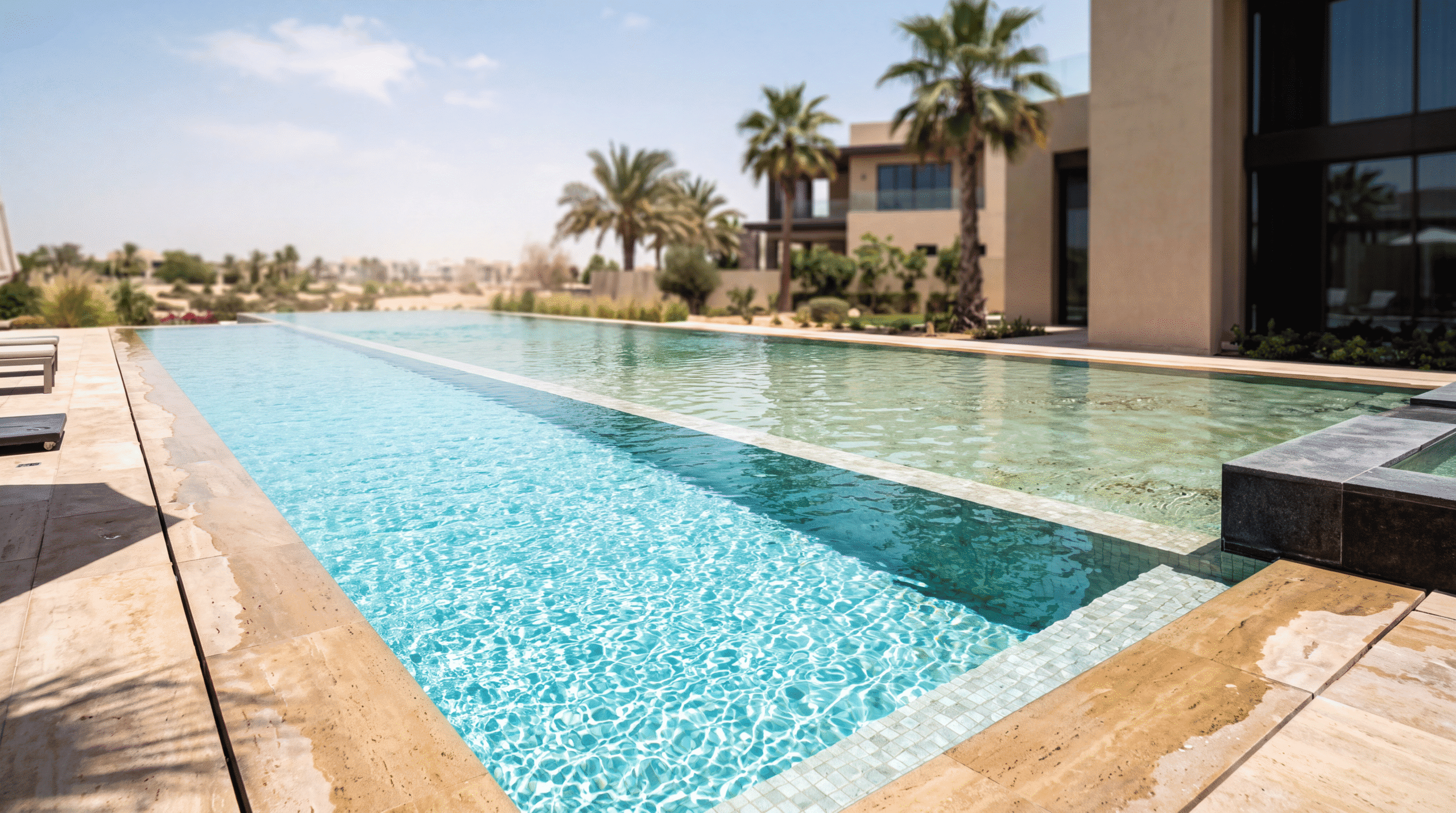
Dubai’s summers break pool chemistry in ways that standard maintenance guides never account for. The advice written for pools in Europe or the United States — test weekly, add chlorine, brush monthly — will leave you staring at green water within a fortnight in July. The conditions here are genuinely different: water temperatures reaching 36 degrees Celsius, sandstorms that deposit fine silica directly into your pool, UV radiation intense enough to destroy an entire chlorine dose in under six hours, and tap water so hard it builds calcium scale on tile surfaces within weeks of a new fill.
Over 13 years and more than 800 pool builds and maintenance contracts across Dubai, our team at Expert Pools has developed a maintenance approach that works for UAE conditions specifically — not a version of the generic advice adapted slightly for the heat. This guide covers exactly what your Dubai pool needs, month by month, problem by problem.
Why Dubai Pools Lose Clarity Faster Than Pools Anywhere Else
Understanding the specific mechanisms at work helps you stay ahead of them rather than reacting after the damage is done.
UV Driven Chlorine Depletion
The first mechanism is UV-driven chlorine depletion. Sunlight breaks down free chlorine by disrupting the hypochlorite ions in the water and releasing chlorine gas into the air. In a temperate climate, sunlight reduces a typical chlorine dose by 30 to 50 percent over several days. In Dubai’s summer, the same dose can be almost entirely gone within four to six hours of direct afternoon sun. A pool that tested at 3 ppm of free chlorine at eight in the morning may read under 0.5 ppm by two in the afternoon — below the minimum safe level. This is not a chemical failure; it is physics responding to the intensity of UAE sunlight.
Bacterial & Algal Acceleration
The second mechanism is temperature-driven bacterial and algal acceleration. Warm water is faster water — chemical reactions, biological growth, and the reproduction of algae and bacteria all increase significantly with temperature. Pool water at 35 degrees Celsius supports algae reproduction approximately four times faster than the same pool at 20 degrees. A single day without sufficient sanitiser at peak Dubai summer temperatures can trigger an algae bloom that takes 48 to 72 hours to clear.
Desert Dust & Sandstorm Decontamination
The third mechanism is specific to Dubai: desert dust and sandstorm contamination. Fine silica particles from desert dust pass straight through standard pool sand filters without being captured. After a significant sandstorm, these particles create persistent turbidity that does not respond to normal filtration — the water looks hazy or faintly grey even though the chemistry is balanced and the filter is running. Addressing post-sandstorm clarity requires a different approach, covered in detail below.
The Right Chemical Schedule for Dubai Summer Pools
The single most important adjustment Dubai pool owners need to make is moving from weekly to more frequent testing and treatment. Weekly chemistry management works in mild climates where chemical consumption is slow and predictable. In Dubai summer, it does not.
| Task | Frequency in Dubai Summer | Why This Matters |
|---|---|---|
| Test free chlorine and pH | Every 48 hours | Heat depletes chlorine 3–4x faster than temperate climates |
| Add stabilised chlorine (cyanuric acid type) | Every 3–4 days | Stabiliser resists UV degradation — essential in UAE sun |
| Shock dose with calcium hypochlorite | Weekly | Breaks down combined chlorines, kills algae before it establishes |
| Test total alkalinity | Weekly | Dubai hard water causes alkalinity to drift upward, destabilising pH |
| Add algaecide (preventative dose) | Every 2 weeks | Treatment before visible algae — far cheaper than remediation after |
| Check and adjust cyanuric acid level | Monthly | Target 30–50 ppm; above 80 ppm renders chlorine ineffective |
| Test calcium hardness | Monthly | Dubai tap water is already high; monitor to prevent scaling |
The most important column in that table is the frequency. Most pool chemistry failures in Dubai happen not because the wrong product was used but because the right product was applied on the wrong schedule. Your pool is consuming chlorine faster than you may realise.
For professional chemical balancing and regular water testing on a schedule that matches Dubai’s seasonal demands, our
For professional chemical balancing and regular water testing on a schedule that matches Dubai’s seasonal demands, our pool maintenance service covers all chemistry management as part of every visit, with a written report sent to you after each service.
Stabilised vs Unstabilised Chlorine
This is the most important product decision a Dubai pool owner makes, and most get it wrong by defaulting to whatever the pool shop had on special.
Unstabilised chlorine — liquid sodium hypochlorite, or the bleach-type products — has no protection against UV degradation. It is effective but short-lived under the Dubai sun. In a pool without a shade structure, an unstabilised chlorine treatment applied in the morning may be significantly depleted by early afternoon.
Stabilised chlorine products — trichlor and dichlor tablets or granules — contain cyanuric acid, which bonds with the chlorine molecule and slows UV breakdown. In Dubai’s high-UV environment, this protection can extend the effective life of a chlorine treatment by three to five times. The trade-off is that cyanuric acid accumulates in the water over time. If you test your cyanuric acid level and find it above 80 ppm, your chlorine becomes largely ineffective regardless of how much you add — a condition sometimes called chlorine lock. At that point, the only remedy is partial water replacement to dilute the stabiliser concentration.
Use stabilised trichlor tablets for routine daily chlorination in Dubai. Use unstabilised calcium hypochlorite shock for weekly shock treatments, where you want rapid impact without adding more stabiliser.
How to Stop Algae Before It Starts
Algae in a Dubai pool in summer is always a prevention problem, never a treatment problem. The moment you can see green, you have already lost several days of good swimming conditions and face a significant remediation effort. The correct posture is to make your pool hostile to algae before it has any opportunity to establish.
The three conditions algae needs to grow in a pool are warmth, light, and phosphates. Dubai provides the first two in abundance. Your job is to eliminate the third and maintain the chemical conditions that prevent establishment even when warmth and light are unavoidable.
- Run your filtration system for a minimum of 12 hours per day in summer, preferably 14 to 16 hours during July and August. Algae cannot establish in well-circulated water because the constant flow prevents the stagnant conditions spores need to colonise a surface. Most pool owners make the mistake of running their pump on the same summer and winter schedule. The summer schedule needs to be significantly longer.
- Brush your pool walls, floor, and steps at every cleaning visit, paying particular attention to corners, behind ladders, around the base of steps, and along the waterline where algae consistently starts before spreading into open water. Brushing disrupts the biofilm that algae needs to anchor before establishing a visible colony.
- Add a monthly phosphate remover treatment. Phosphates enter your pool from tap water, from sunscreen and cosmetics on swimmers, and from organic matter including windblown plant material. Removing phosphates cuts off algae’s primary food source.
Our professional pool cleaning service includes all algae prevention steps — chemical treatment, brushing, filter management, and phosphate testing — as part of every routine visit. Pool owners who switch from self-maintenance to a professional schedule consistently see fewer algae incidents and lower overall chemical costs.
Sandstorm Aftercare: The Dubai-Specific Protocol Nobody Else Covers
A moderate Dubai sandstorm introduces more contaminants into your pool in a few hours than weeks of normal use. The silica particles are small enough to pass through standard sand filtration media without being captured, which is why a hazy appearance can persist for days after a sandstorm even when the chemistry is correct and the filter is running continuously.
After any significant sandstorm, follow this protocol in this order:
- Run the pump continuously for six to eight hours immediately after the storm ends. This passes the maximum volume of water through the filter as quickly as possible and removes the larger particles that the filter can capture.
- Backwash your sand filter even if the pressure gauge does not indicate it is needed. Fine silica loads the filter media without necessarily raising the pressure reading enough to trigger the normal backwash threshold. Backwash anyway.
- Add a dose of clarifier. Pool clarifier works by causing fine particles to clump together into larger particles that your filter can then capture. It is specifically effective against the fine silica that sandstorms introduce.
- Shock the pool. Organic matter in sandstorm dust — dried plant material, soil compounds — rapidly consumes chlorine. A shock treatment immediately after a sandstorm is preventative maintenance against the chemistry collapse that follows large organic loads entering the water.
- Check the skimmer baskets every few hours until they stop filling quickly. When skimmer baskets overflow, debris bypasses the skimmer entirely and either sinks to the pool floor or is drawn into the main drain instead of being captured. During storm aftermath, baskets fill much faster than under normal conditions.
Pool Temperature Management in Dubai
Water temperature management is the maintenance topic that surprises most people who move to Dubai from cooler climates. The immediate assumption is that a heated pool might be nice in winter. The less obvious reality is that cooling the pool in summer is the significantly more important intervention.
Dubai pool water reaches 34 to 37 degrees Celsius in July and August in an uncooled pool. At those temperatures, the pool is not a refreshing escape — it is a warm bath, uncomfortable for adults and genuinely exhausting to swim in. More consequentially for water quality, water above 30 degrees Celsius supports bacterial growth and algae reproduction at rates that make it genuinely difficult to maintain adequate sanitiser levels regardless of how diligently you test and treat.
A pool chiller — installed on the plant room equipment and plumbed into the circulation loop — cools the water to a set target temperature, typically 26 to 28 degrees Celsius. In practical terms, this is the difference between a pool that your family uses every single day from April through October and a pool that sits unusable during the five most intense months of the year.
Pool chiller units for residential pools cost AED 15,000 to AED 40,000 installed, depending on pool volume and the chiller capacity required. Expert Pools installs chillers as part of new pool construction projects and retrofits them to existing pools. We plumb every pool we build with chiller connections already in place, even when a client does not install the unit immediately, because almost every Dubai pool owner eventually does.
Signs Your Pool Chemistry Needs Professional Attention
Some water quality problems are clear signals that standard home maintenance is not resolving the underlying cause, and that the pool needs professional diagnosis before the situation worsens.
Water that remains green or cloudy more than 24 hours after a full shock treatment indicates either a severely depleted chemistry baseline, a filtration problem, or a biological load too large for chemical treatment alone. Professional intervention with commercial-grade treatment and equipment flushing is the appropriate response.
A persistent strong chlorine smell at the water surface — the smell most people associate with over-chlorinated pools — is actually the smell of chloramines, which form when chlorine combines with nitrogen compounds from sweat, urine, and organic matter. Counterintuitively, chloramine smell means not enough free chlorine relative to the nitrogen load, not too much. The solution is breakpoint chlorination: adding enough chlorine to destroy all existing chloramines before restoring the pool to normal operating levels.
White or grey scale on tiles at the waterline, particularly appearing within weeks of a water change, indicates calcium hardness is too high. Dubai’s tap water arrives at calcium hardness levels of 400 to 600 ppm — two to three times the recommended pool level of 200 to 400 ppm. Addressing this requires either diluting the pool water with lower-hardness water or adding a sequestering agent that keeps calcium in solution rather than allowing it to deposit on surfaces.
Our repair and diagnosis service includes water quality diagnosis for persistent clarity and chemistry problems that have not responded to standard treatment. If you are spending significant time and money on chemicals without achieving consistently clear water, the problem is usually identifiable and fixable with the right diagnosis.
Weekly Maintenance Checklist for Dubai Pools
| Task | Summer (May–Sep) | Winter (Oct–Apr) |
|---|---|---|
| Test free chlorine (target 2–4 ppm) | Every 2 days | Twice weekly |
| Test and adjust pH (target 7.2–7.6) | Every 2 days | Twice weekly |
| Test total alkalinity (target 80–120 ppm) | Weekly | Weekly |
| Shock treatment | Weekly | Every 2 weeks |
| Algaecide preventative dose | Every 2 weeks | Monthly |
| Skim surface debris | Daily | Every 2 days |
| Brush walls, floor and steps | Weekly | Weekly |
| Empty skimmer and pump baskets | 3x weekly | Weekly |
| Vacuum pool floor | Weekly | Weekly |
| Backwash filter | Weekly or as pressure indicates | Every 2 weeks |
| Run filtration pump | 12–16 hours daily | 8–10 hours daily |
| Check chiller/heater target temperature | Daily | Daily |
| Post-sandstorm protocol (shock, clarifier, backwash) | As needed | As needed |
Frequently Asked Questions
How often should I test my pool water in Dubai summer?
Every 48 hours as a minimum during May through September. Daily testing is advisable during July and August when heat is most extreme and chemical consumption is fastest. Testing in the morning before peak sun gives you the most accurate baseline reading before the day’s UV and heat affect the numbers.
Why does my pool keep turning green even though I add chlorine regularly?
In Dubai, the most common cause is unstabilised chlorine being completely depleted by UV before it has time to work. Switch to stabilised trichlor tablets for daily dosing and use calcium hypochlorite shock weekly. Also check that your cyanuric acid level is between 30 and 50 ppm — if it is above 80 ppm, your chlorine is chemically blocked from working regardless of how much you add.
How long should I run my pool pump in summer?
Minimum 12 hours per day in summer. 14 to 16 hours is better during July and August. Algae cannot establish in properly circulated water, and longer filtration run times significantly reduce the chemical load you need to maintain clarity. Run the pump during peak daylight hours when algae growth is fastest.
My pool is hazy after a sandstorm. What should I do?
Run the pump continuously, backwash the filter, add a clarifier dose, and shock the pool. The haziness after sandstorms is caused by fine silica particles that your filter cannot capture without clarifier. The process takes 12 to 24 hours to clear fully. Do not add extra chlorine beyond the shock dose without retesting first.
Does a pool in Dubai really need a chiller?
If you want to use your pool between May and September, yes. Without a chiller, water temperatures reach 34 to 37 degrees Celsius — uncomfortable to swim in and counterproductive to good water chemistry. With a chiller set to 27 degrees, your pool is genuinely refreshing and significantly easier to maintain chemically throughout the summer.
For a professional pool maintenance contract covering weekly visits, all chemistry management, equipment checks, and post-storm protocols across Dubai, WhatsApp us at +971 50 753 9316 or visit our pool maintenance page for a free quote.
See also: How Much Does a Swimming Pool Cost in Dubai?